
Elavon debits, fees, chargebacks and declines: common questions
A debit shown as ELAVON MRCH SVC on your bank account is from Elavon, your card processor. It can be one of a few things: your monthly statement fee, a negative batch (for example a day with only a refund), a chargeback, a terminal swap fee (a $45 debit is likely a swap) or a supply order.
On this page
Why did Elavon debit my account?
First check that the debit really is from Elavon. It normally shows as ELAVON MRCH SVC. An Elavon debit can be one of these:
- Monthly statement fee. Taken around the 1st of the month for the previous month’s processing. Compare the amount with your statement: access your statements in Payments Insider.
- A negative batch. If a day’s batch held only a refund, or its net total was below zero, the difference is debited. You can see the payment details and the transactions in that batch in Payments Insider under the Payments Report.
- A chargeback. A disputed transaction is debited 3 – 5 business days after the dispute notification is issued. You can view and manage chargebacks in Payments Insider.
- Swap fee. A $45 debit is most likely a terminal swap. It usually appears on your merchant statement, but is sometimes debited on its own.
- Supply order. Supplies you ordered from Elavon, such as paper rolls or replacement cords.
What fees might I see on my statement?
What is a Minimum Bill / Monthly Minimum fee?
If your account has one, it is the lowest amount the processor expects to bill you each month. The fee is the minimum bill amount minus the processing fees you were actually charged that month. If your fees go over the minimum, there is no minimum fee that month. If you don’t process at all in a month, you are charged the full minimum bill amount.
What is the $16 DB FEE / Pulse network participation fee?
US merchants who accept PIN debit pay yearly fees to take part in the PIN debit networks. They appear under payment network and associated fees.
| Network | Annual fee | Usually billed |
|---|---|---|
| Accel | $16 per year | October to December |
| Jeanie | $12 per year | October to December |
| NYCE | $16 per year | June to August |
| Pulse | $16 per year | September to November |
| STAR | $16 per year | October to December |
What are GEMS rejects / exceptions?
They are adjustments for transactions that could not be completed after funding. Either you were funded for a sale that could not be collected from the cardholder, so the processor takes the funds back, or a refund could not be paid to the cardholder, so the processor returns the funds to you.
How do chargebacks and retrievals work?
I received an odd-looking email about a dispute. Is it safe to open?
It may be a dispute notification from Elavon.
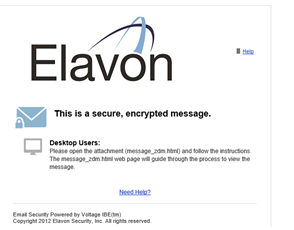
Elavon sends out dispute notifications via a secure encrypted email message. The subject line is in the following format: Dispute [1234567890011183154526] key123 where the first 10 numbers is the case number. These emails will also have an attachment message_zdm.html. To view the email, double click on the attachment. If this is the first time opening up an Elavon secure email you will first need to register and set secuity questions and a password. Otherwise if you already have done this step, click to read message and login with your secure email password.
What is the difference between a chargeback and a retrieval?
Either the cardholder or their issuing bank can dispute a transaction they have a problem with.
- Retrieval request (sometimes called a soft chargeback): the cardholder doesn’t recognize a charge and asks their card issuer to get more information about it from you.
- Chargeback: the cardholder disputes the transaction and asks for it to be reversed. Common reasons include goods not received, items not as advertised, fraud and a cancelled recurring subscription.
How long does a cardholder have to request a retrieval or dispute a charge?
Retrievals can be requested up to 18 months. For most chargebacks the window is 120 days (180 days for international transactions) from the original transaction date or from when the product or service issue was discovered. Some reason codes allow longer.
How long do I have to respond to a chargeback or retrieval?
You have 30 days to respond to a dispute or chargeback. The card issuer then has up to 30 days to review the case. If the funds are returned to you, the cardholder has 30 days to challenge that decision.
What are chargeback pre-arbitration and arbitration?
Pre-arbitration is a second chargeback on the same transaction, which happens after you win the first dispute. If the parties still can’t resolve it, the case can go to arbitration, where the card network decides. Arbitration is a last resort, and for most transaction sizes it isn’t worth the cost: responding to a pre-arbitration or arbitration case can bring fees from $150 – $500+.
Why is there a chargeback fee even when the transaction was valid?
The chargeback fee applies to every chargeback, whatever the outcome. It covers the administrative cost of handling the chargeback.
What do authorization and decline messages mean?
Why doesn’t my refund have an authorization code?
A refund doesn’t get a new code. It uses the original sale’s auth / approval code, because approval codes are only issued when a charge to a card is approved.
What does a Declined 79 response mean?
It means the transaction needs approval from the auth centre. Call the auth centre to get it approved (see “What does Call Auth Center mean?” below).
What does Call Auth Center mean?
The bank is unsure about the transaction and wants you to call the processor to verify it. If it is approved, you get an approval code to capture the sale.
What does “Pick Up Card” mean?
It is a decline from the card issuer because the card has been reported lost or stolen and flagged as fraudulent.
How long does an authorization stay on a card?
Typically 7 days.
How can I remove / drop an authorization from a cardholder?
You can wait for it to drop off by itself, or force a sale for $0.01. Another option is to force the sale for the full amount and then void that sale. Even after forcing, the cardholder may still see the original authorization for a while. In some cases we can work with the processor to have the authorization dropped.
What is the Visa force post mandate, and does it cover other card brands?
A force post (or forced sale) is a sale you enter using an approval code, instead of sending it for a new authorization. Controls have been put in place to stop forced Visa transactions that have no matching authorization from being processed, settled and funded. This is being rolled out for all card brands (Visa, MasterCard, American Express, Discover and Union Pay). If a transaction wasn’t authorized, or has no matching auth code from the acquirer and the card-issuing bank, it declines when you run it or is voided from the settlement batch, and you are not funded for it.
If you have a legitimate business need to submit a force post transaction, contact the Voice Authorization Center and they will explain your options.
What do I do about terminal batch problems?
The terminal says the batch must be settled, but it was already settled and funded
If you have confirmed you were funded for that batch, you can delete the batch from the terminal.
What is a host reversal?
It can happen when two physical terminals run with the same terminal ID. The transaction is approved and prints a sale receipt, then reverses in the same second. That transaction is then missing from the batch, and the terminal won’t let you settle.
- If only one transaction is affected (the usual case): delete the batch and force the transaction through with the original auth code.
- If several transactions are in the batch: have the processor settle on their end, then delete the batch on the terminal.
Then do a download so the terminal has the correct terminal ID.
Why are my Amex customers not receiving supermarket rewards?
It depends on how your merchant account is coded. If you are on our Amex Opt Blue program, check with us. If you are with Amex direct, it depends on how Amex has you coded.
What are the account and website requirements?
What do I need for an ammunition or firearms merchant account?
- USA: you need an FFL (federal firearms license) to sell firearms card-not-present. This covers working guns and also lower receivers, the part that carries the serial number. Other parts and ammunition (scopes, magazines, triggers, springs, barrels, ammunition and so on) don’t need an FFL.
- Canada: online gun sales can ship to a residential address as long as the seller can confirm the buyer’s PAL (Possession Acquisition License).
Because of the ATF gun laws that took effect August 24, 2022, you must comply with those regulations to keep a merchant account.
Website review says my eCommerce site is missing requirements. What do I need?
If customers enter card details on your website, the site has to meet Visa and MasterCard requirements. Many things are recommended (card brand logos for the brands you accept, delivery method and timing, a privacy policy and so on), but these are required to pass website review:
- Payment page needs to be secure SSL (https://) webpage
- Business name to be listed
- Contact information to be listed
- Return / refund policy to be outlined
Does a mobile app need website review?
No. If cardholders pay inside a mobile app rather than on a website, no website review is needed. Let us know so we can mark the account compliant.
Can I get next day funding through a gateway on the TSYS network?
A foreign network such as TSYS can’t guarantee next day funding. TSYS usually sends its file feed after the next day funding cut-off time.
Common questions
What is ELAVON MRCH SVC on my bank statement?
It is a debit from Elavon, your card processor. See “Why did Elavon debit my account?” above for what it usually covers. If you still can’t match it, contact Cartis Payments at 1-888-712-0770 or support@cartispayments.com.
Who do I contact about an Elavon chargeback or dispute?
You can view and respond to chargebacks in Payments Insider. For help with a case, contact Cartis Payments at 1-888-712-0770 or support@cartispayments.com.
Updated November 2, 2026
Still stuck? Talk to a person.
Our team answers the phone.
Looking at your processing costs? See the Cartis payment gateway